Michael Palmer and Teruichi Harada
Japanese writer Mitsuki Wanaka has produced a series of blog posts which purport to refute Palmer’s book “Hiroshima Revisited” [1]. The book makes the case that the bombings of Hiroshima and Nagasaki were not atomic, but were instead staged with the use of conventional explosives, napalm, and mustard gas. It has also been published in Japanese under the title “The Staged Atomic Bombings” (translated by Harada). While most of Wanaka’s arguments are lacking in substance, his series of posts is nevertheless a skillfully crafted piece of propaganda. To achieve this effect, Wanaka uses the following techniques:
- He starts his critique at the wrong end of the book. HR constructs its case from the ground up, such that most of its chapters build on the preceding ones. By addressing HR’s arguments out of sequence, Wanaka creates a completely false impression of the book’s line of argument.
- Wanaka grossly misrepresents or entirely omits the key arguments that disprove the atomic bombings and support the use of mustard gas and of napalm.
- Instead of actually refuting the HR’s key arguments in substance, he merely opposes by quoting unsubstantiated assertions of fact from official reports. These quoted assertions often amount to direct lies.
- Wanaka criticizes some of HR’s contentions as being insufficiently supported by the evidence. However, HR presents none of those statements as firm conclusions, but merely as plausible hypotheses. Moreover, none of them are crucial for the book’s central thesis.
Addressing every single one of Wanaka’s misleading statements in a single post would be a very lengthy and dreary exercise. Therefore, in this post, we will focus on some pertinent examples that should sufficiently illustrate Wanaka’s deceptive tactics and his lack of substantive arguments. We will begin by summarizing HR’s line of argument and key evidence. After that, we will examine some of his specific arguments.
Some of Wanaka’s more technical criticisms will be addressed in future posts on specific topics. In fact, one such technical post has already been published.
The proper sequence and hierarchy of HR’s evidence
Wanaka starts at the wrong end of the book by discussing the hypothetical non-nuclear scenario of the bombings and the physical studies on neutron-induced radioactivity. He thereby creates the false impression that these chapters are central to HR’s case against the atomic bombings. To set the record straight, we will briefly recapitulate HR’s actual line of argument, which is spelled out in the book’s first chapter (Section 1.5, “The evidence in the case”).
- There is strong, “hard” evidence both for and against the atomic bombings. The contradiction is in the evidence itself, not merely in peoples’ subjective interpretations of it. Therefore, not all of this evidence can be true—some of it must have been fabricated.
- To determine which evidence was fabricated, we must ask: what kinds of evidence could possibly be fabricated?
- Some crucial evidence against the atomic bombings consists of direct observations that were made immediately after the attack. One important example is the unshielded survival of multiple persons near the hypocenter. Survival cannot be fabricated. The same applies to further negative evidence that will be discussed below.
- In contrast, the “hard” evidence that supports the atomic bomb story consists largely of laboratory experiments. Such data can easily be forged. The same applies to the famous “atomic shadows.”
- The only rational conclusion is that the negative evidence must be accepted as valid, whereas the positive experimental evidence must have been fabricated.
This conclusion is clearly stated in HR, as follows (Section 8.1.2):
If a physical measurement or calculation indicates that lethal radiation prevailed at a certain time and place, but a human who was present then and there survived, then this biological outcome categorically falsifies the physical statement.
And since survival near the alleged nuclear detonations is a proven fact (see below), all the experimental studies on neutron and gamma rays must be categorically dismissed as fake. Accordingly, those of HR’s chapters that deal with these experiments are not intended to prove that these data were faked. Instead, their purpose is merely to illustrate, by example, that they were faked poorly and inconsistently. Wanaka’s effort to distract from the many clear examples of fakery by pointing to other studies that were faked rather more skillfully is therefore completely beside the point.
Similarly, the conclusion that the atomic bombings were staged is not based on any part of the hypothetical scenario of a conventional attack described in Chapter 13. Regardless of whether or not this scenario is correct, evidence such as the presence of numerous survivors at the hypocenter definitively refutes the occurrence of a nuclear explosion. Therefore, while our hypothetical scenario might need to change if new evidence emerges, such changes would not affect HR’s fundamental thesis.
Unshielded survival near the hypocenter disproves the atomic bombings
Because the entirety of the evidence is full of contradictions, it can be confusing. However, we can get our bearings by focusing on one crucial fact that even in isolation suffices to refute the story of the atomic bombings. This concerns the people that survived near the hypocenter, either out in the open or with minimal shielding.
That there were such survivors is acknowledged even in orthodox sources. One such source is the official report to the US government by Oughterson et al. [2]. Aside from providing a considerable amount of statistical evidence, the authors also commented explicitly that “it is … difficult to explain the complete absence of radiation effects in … people who were theoretically exposed to lethal dosages of radiation” [3]. This comment was, of course, the understatement of the year—unharmed survival is not just “difficult” but strictly impossible in the face of lethal irradiation, to which we must add the extreme heat and the blast wave of the detonation. And the evidence is not limited to these reports by Oughterson and colleagues. HR cites further sources, among them statistics published by the “Radiation Effects Research Foundation” (RERF), which can be considered the headquarters of the atomic bomb orthodoxy. If even RERF inadvertently “leaks” such data, anyone with a bit of common sense will understand that the jig is up.
Additional relevant sources doubtless exist. While HR is largely based on documents available in English, independent historian Chikatsu Hayashi has shown that Japanese sources provide further confirmation. His recent book “Hiroshima and Nagasaki. The truth about these tragedies” (so far available in Japanese only) features some first-hand testimony from survivors who had been near the hypocenter. We wholeheartedly recommend this valuable book to our readers.
Where does the evidence of unshielded survival leave us?
The official atomic bomb narrative must already be considered disproved at this early stage. However, the following questions should also be examined:
- Have we overlooked any evidence that contradicts our verdict, and that could not possibly have been faked?
- What can the physical, medical and documentary evidence tell us about the methods that were used for staging the atomic bombings?
- What may have been the motive and purpose of the deception?
Regarding the first point: we have found no “fake-proof” positive evidence of the atomic bombings. Neither has Wanaka. Failing that, he argues that a deception on such a large scale is implausible, bordering on the impossible. We agree with him that the deception is indeed remarkable in its scale and audacity. However, it is not unique in this regard—there are other examples.
The second question—namely, which tools and weapons were used to create the deception—is the subject of many of HR’s chapters. We believe that some of our conclusions are robust and well supported, whereas others are more tentative. Given that much of the evidence remains hidden even now—eighty years after the events—this state of affairs should not be surprising. On the other hand, our investigation of the means and methods did unearth substantial further evidence against the atomic bomb story itself.
Thirdly, regarding the purpose of the deception, we must of course again largely rely on inference and plausibility. This is clearly stated in the book. Therefore, Wanaka’s criticisms that we didn’t “prove” this or that tentative statement—for example, that Stalin had not been taken in by the fake atomic bombings—are completely pointless.
What other evidence is there to disprove the story of the atomic bombings?
Since we have clearly spelled out the evidence in our book, here a brief summary should suffice. Aside from the survival near the hypocenter, there are:
- the survival of trees, flagpoles and regular steel-concrete buildings near the hypocenter, which proves that no violent blast wave occurred that would have matched the strength of the alleged nuclear detonation;
- the absence of retinal burns among survivors who report having seen the “nuclear” flash;
- the absence of nuclear fallout in both cities commensurate with true nuclear detonations;
- the protocol, initially classified, of a secret meeting of the “Manhattan Project’s” top scientists with military and political leaders on May 31, 1945 [4]. The scientists’ statements at this meeting unequivocally imply that at the time purified plutonium was not yet available, and that it would take at least two more years to build a bomb of the Nagasaki type.
All of this evidence is well documented. Most of it could not have been fabricated; the only exception in this list is the meeting protocol. But what could have been the point of fabricating, then classifying, and finally declassifying such an embarrassing protocol? The idea is obviously absurd.
Rebuttals to some of Wanaka’s flawed arguments
We here merely aim to illustrate by example the deceptive nature of Wanaka’s arguments. In the main, we can let HR fend for itself. Readers who peruse the book will find that most of Wanaka’s criticisms are already sufficiently addressed in the text.
Survivors near the hypocenter
In spite of the plentiful evidence outlined above, Wanaka’s attempts to deny that there were any people who survived near the hypocenter without shielding. To this end, he adduces a paper by Kamada [5] that discusses the whereabouts during the bombings of 78 persons who had been within 500 meters of the hypocenter. While most of them had been inside solid buildings that might have shielded them from radiation, seven had been riding on streetcars. Twelve others had been “exposed in or near their own house,” which likely means that some of them had been out in the open without any shielding at all. Moreover, most dwellings in prewar Hiroshima had been constructed from wood.
Wanaka comments that Kamada’s paper “does not provide details on the shielding for the 12 people who were inside or near their homes, nor does it specify the degree of shielding provided by streetcars and other structures.” He thereby creates the misleading impression that such information is unavailable. However, the very limited shielding effect of wooden buildings was documented in detailed experiments that were carried out in connection with later bomb tests, as described for example by Auxier [6]. Streetcars have thinner walls than wooden houses and surely would have provided even less shielding. The conclusion is unavoidable that within 500 meters of the hypocenter survival inside wooden houses or streetcars would have been impossible. The study cited by Wanaka therefore does not help his case at all; instead, it only adds to the evidence of unshielded survival.
Did the victims’ symptoms match those of mustard gas poisoning?
HR discusses the various known manifestations of mustard gas poisoning in some detail before examining the available evidence from Hiroshima and Nagasaki, to demonstrate that the victims in both cities indeed suffered the typical signs of mustard gas exposure. This applies to the acute manifestations which concern the lungs and intestines, the circulation and the skin. It also applies to the delayed manifestations that result from bone marrow failure, as well as to long-term effects such as cancer and leukemia.
Generally speaking, there is of course substantial overlap between these effects and those of true radiation, and this similarity most likely suggested the use of mustard gas to fake radiation sickness among the victims. However, acute effects such as skin blisters, acute respiratory distress and capillary leak syndrome permit us to identify mustard gas rather than radiation as the true cause of disease and death among the victims.
Wanaka raises a number of ill-informed objections to this conclusion. One of them is that the effects in the victims occurred too soon; apparently, he has read somewhere that mustard gas takes effect only with delay. However, high doses of mustard gas cause a more rapid onset of toxic effects. In their report on Iranian soldiers who were exposed to mustard gas in the Iran-Iraq war of the 1980s, Freitag et al. [7] write:
According to the reports, many soldiers died immediately on the battle field, probably due to acute chemical-induced pulmonary edema. … The soldiers reported that they first noticed a bitter taste and a garlic-like smell immediately after the exposure to the poison gas. Minutes to hours later, dizziness, headaches, and shortness of breath were common complaints. Immediately after exposure, a hemorrhagic inflammation and erosion of the exposed mucosa were observed.
Nevertheless, it is true that in many cases the respiratory symptoms of mustard gas poisoning become fully manifest only with delay of some hours. And precisely that is evident in the report by the physician Dr. Tatsuichiro Akizuki [8], from which Section 10.1 of HR cites at length. In summary, in trying to make the case against mustard gas, Wanaka has presented another incomplete, misleading and ineffective argument.
On retinal burns
HR goes to some lengths to demonstrate that retinal burns
- were observed both in humans and in experimental animals on the occasion of later bomb tests, even at large distances;
- should have affected all people who looked at the flashes Hiroshima and Nagasaki;
- are not found in medical case reports on victims of the alleged atomic bombings.
There exists, however, one short report in Japanese concerning a survivor who exhibited afflictions of the anterior eye, and in addition “degenerative lesions” rather than burns of the retina [9]. This report has falsely been cited in the American literature as evidence of retinal burns.
A single such case is also mentioned, but without any citation at all, in a “reference work” on atomic weapons [10]. Wanaka quotes this work of fiction en lieu of actual evidence. He also quotes from the same source another “argument” of truly breathtaking stupidity:
Another possible explanation is that the recessed position of the eyes and, in particular, the overhanging upper lids served to decrease the direct exposure to thermal radiation. Furthermore, on the basis of probability, it is likely that only a small proportion of individuals would be facing the explosions in such a way that the fireball would actually be in their field of vision.
The “recessed position” of the eyes obviously does not prevent light (including UV and infrared light) from entering them; otherwise they would be of little use to us. As to the upper eyelids and the proportion of people actually gazing at the fireball: there were plenty of eyewitnesses who reported having looked at the flash. They all should have had their retinas burned and scarred. How many people did not look at the flash is completely irrelevant.
The absence of retinal burns in both cities also means that the fake “nuclear” flashes could not possibly have caused any burns to the skin. Thus, the many reported “flash burns” to the skin must have been due to other causes.
Were the skin burns really caused by the nuclear flash?
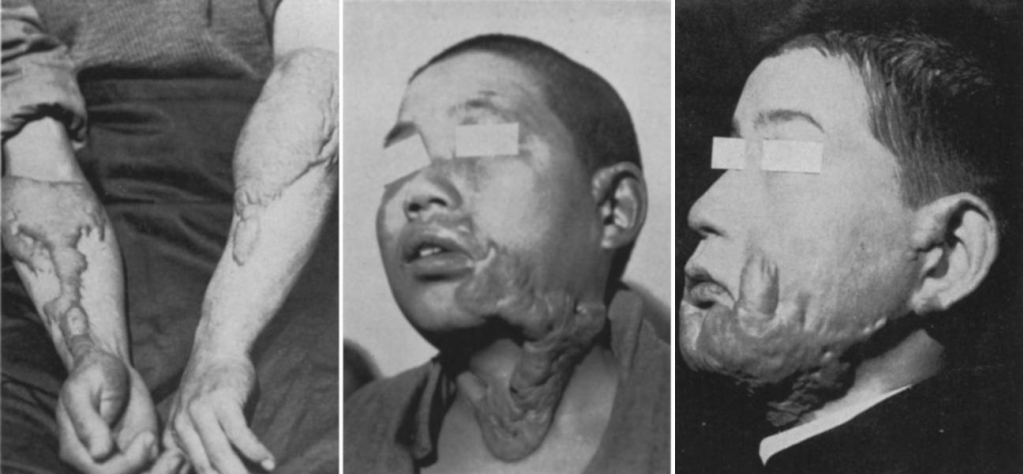
On this topic, Wanaka again has nothing to offer but an affirmation of official lore, quoting from his preferred fictional “reference work” [10] that “a distinct feature of thermal radiation (flash) burns was their sharp limitation to exposed areas of the skin facing the center of the explosion.” This statement does, of course, not agree with the facts. HR discusses various kinds of burns that do not fit this pattern at all. Some striking examples were taken from an early study by Block and Tsuzuki [11]. These are shown here in Figure 1. The hypertrophic scars or keloids in the two burn victims from Hiroshima are sharply delineated against the surrounding healthy skin. The outlines of these scars are completely irregular. There just isn’t any conceivable manner in which partial shielding from the flash could have produced these shapes. On the other hand, the aspect of the scars strikingly resembles that in the third victim who received his burns in the conventional bombing raid on Tokyo. A typical cause of burns of this kind is napalm.
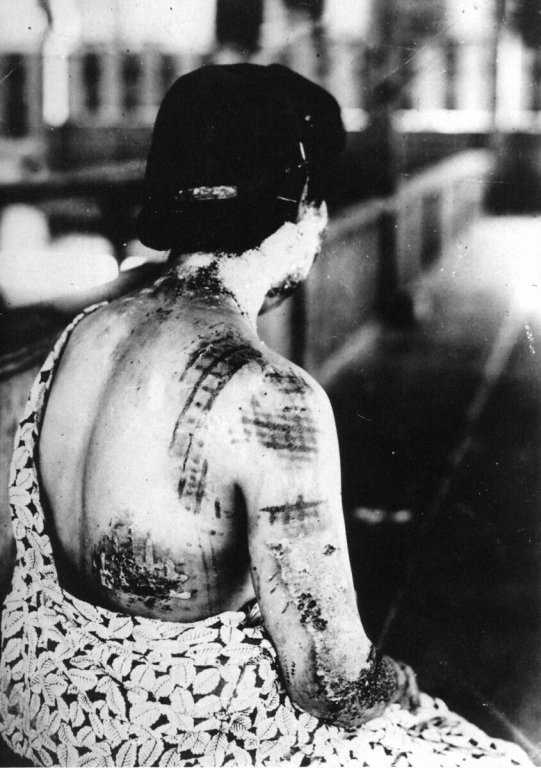
Wanaka also states that “there were a few cases where burns occurred through clothing.” He then discusses the “classic” picture of a kimono pattern transferred, through an alleged flash burn, onto the skin of a woman from Hiroshima (Figure 2). This picture, however, is not at all convincing. The patient shows circumscribed, deep third- to fourth-degree burns on the lower back and the forearm. On the upper arm, there appears to be another deep burn that is covered up. However, other skin areas close by remain intact. Black cross-hatch markings have been painted onto parts of that intact skin in order to create the impression of the transferred kimono pattern.1
1 HR states that flash burns to the skin should not occur underneath clothing that remains intact. Wanaka rightly points out that this may be incorrect. However, clothing that is merely overheated but not set alight will hardly produce deep burns such as those seen in this picture. Moreover, in a significant percentage of patients, burns were limited exclusively to skin areas that had been covered with clothes, whereas the exposed skin areas had not suffered.
possibly appear in a burn caused by heat.
In addition to the appearance of individual burn patients, there also is statistical evidence that contradicts the official story. In neither city does the distribution of burn incidence and severity show the expected decreasing trend with increasing distance from the hypocenter. This and other evidence is discussed in more detail in HR, Chapter 9.
Physical studies on bomb radiation and radioactive fallout
These studies are really quite technical, and we will therefore save most of the material for later. However, Wanaka’s general approach to these topics is to address none of our major arguments in substance. Instead, he focuses entirely on minor inaccuracies or unanswered questions in our book, whose significance he inflates out of all proportion. To illustrate this, we will here discuss his treatment of HR’s fourth chapter, which deals with measurements of radiation on the ground that were conducted in the first days after the bombing.
The significance of such early radiation measurements is that at this early time much of the short-lived fallout and neutron-induced radioactivity should still have been detectable, but its level should have dropped significantly day by day. Observing such an initially high but rapidly decreasing radiation signal could have confirmed some kind of nuclear detonation, be it large or small. Wanaka, however, does not address this central question at all. Instead, he focuses entirely on litigating one single footnote in the chapter. The incriminated footnote reads as follows:
The only report I have found of an even earlier measurement is that by Toland, who states that Dr. Fumio Shigeto, then vice director of the Hiroshima Red Cross hospital, used an X-ray dosimeter to detect radiation at the hospital on the day after the bombing (August 7th) and found very little. Toland and Liebow also report that X-ray film stored in sealed packages within the same hospital was blackened after the bombing. This observation is often cited as evidence of ionizing radiation released in the blast, but while it may have prompted Dr. Shigeto’s measurements, the negative outcome of the latter suggests that the films may have become blackened in some other manner, e.g. by exposure to heat when the hospital was burning. …
The only important detail here is of course that Dr. Shigeto’s very early measurements revealed little radiation. Wanaka, however, entirely disregards this aspect and dedicates an entire post to the question whether heat or bomb radiation had blackened the film; citing from various official sources, but reaching no definitive verdict.
It is of course perfectly possible that the film was not blackened by heat, but that it was just one more piece of fake evidence of bomb radiation. Nothing would have been easier than to expose some X-ray film inside its packaging to an X-ray source and then shove it back onto the shelf. Wanaka’s energetic pursuit of this trite question serves only to distract the reader’s attention from the central finding of the chapter: the expected initially high but short-lived radioactivity is not substantiated in any of the scant reports on measurements that were conducted in the immediate aftermath of the bombings.
Wanaka uses essentially the same approach to evade other physical arguments that run counter to the official narrative. As stated above, these questions will be addressed later in separate posts.
The feasibility of the mustard gas attacks
In his zeal to disprove that HR’s thesis that mustard gas was used in the fake atomic bombings, Wanaka presents some truly mind-boggling numbers for the amount of mustard gas that would have been needed. His calculation is built on the following assumptions:
- The total death toll of the Hiroshima bombing was 140,000. All of them would have been killed by mustard gas.
- At Ypres, where one of the major battles of World War 1 was fought, the amount of mustard gas that had been needed for killing one enemy soldier had worked out to 1.3 tonnes on average.
By multiplying these two numbers, Wanaka determines that 180,000 tons of mustard gas would have been needed in the attack on Hiroshima. He further deduces that 30,000 B-29 bombers would have been required to deliver this enormous amount of mustard gas.
Wanaka’s calculation is of course fanciful. The first thing to note is that the total death toll at Hiroshima was likely lower than 140,000. According to Nishimura [12], Colonel Crawford Sams, the highest-ranking American medical officer in Japan after the war, put the total number of fatalities at half that number (72,000). What is more, he stated that “only 3000 to 5000 had died instantly from the explosion, proving that the atomic bomb was not as efficient a military weapon as the traditional incendiary bombs.” In an interview which he gave in 1979 [13], he put the number of immediate deaths even lower:
When the bomb went off, about two thousand people out of 250 thousand got killed—by blast, by thermal radiation, or by intense X-ray, gamma radiation. Then, what happened is like an earthquake. The blast knocked down houses, hibachis had turned over and started fires. … As near as we could figure then, about twenty-one thousand people died in thirty-six hours as a result of being trapped and burned and so on.
Whether or not we choose to believe his very low estimate of immediate deaths, Sams is certainly correct in pointing out that many of the immediate and early deaths must be attributed to the collapsing and burning houses, just as happened in conventional bombings.
The next consideration is the amount of mustard gas needed. The US National Academy of Sciences estimates that people breathing air which contains 1.5 grams of mustard gas per cubic meter will succumb if the exposure lasts one minute [14]. The decisive parameter is the product of exposure time and concentration of the poison; therefore, one tenth of the stated concentration would cause death after an exposure for 10 minutes. Note that an exposure at just above this limit would cause delayed rather than immediate death.
How high might the concentrations of mustard gas in Hiroshima and Nagasaki have been? Some of Dr. Akizuki’s patients succumbed some hours after they had been exposed only for a few minutes. Let us therefore assume that they had breathed mustard gas at a concentration of 1 gram per cubic meter. How many cubic meters of air had been saturated to that concentration? Let’s assume that the affected area had a size of one square kilometer, and that within this zone the air was saturated to a height of ten meters. This gives ten million cubic meters of air. As many grams of sulfur mustard would amount to ten metric tons.
Is this estimate realistic? A historical treatise on the US Army’s chemical warfare preparations in World War 2 [15] provides useful context. Firstly, it confirms that the US had indeed prepared extensively for the use of mustard gas and stockpiled not only bombs but also spray tanks filled with mustard gas in large numbers. According to this source, a plane carrying about 600 kilograms of mustard gas in spray tanks could saturate an area of approximately 40,000 square meters. This means that 25 such planes would have sufficed to cover the assumed target area of one square kilometer. About 15 grams of mustard gas would have been delivered per square meter. This would have saturated the lowermost ten meters of the atmosphere to a concentration of 1.5 grams per cubic meter. It is quite possible though that the concentration near the ground would have been even higher.
What is more, the same source also reports that between 1943 and 1945 the US Army had been conducting extensive trials on spraying mustard gas from airplanes at both low and high altitude in order to optimize chemical additives, droplet size etc. It thus seems quite possible that the mustard gas in Hiroshima and Nagasaki was dispersed not by bombs but rather by spraying. This would address Wanaka’s objection that there are no reports on undetonated mustard gas bombs having been found on the ground.
The scale and the purpose of the deception
Wanaka points out that a large and long-lasting effort would have been needed to create and to maintain the atomic bomb deception. This is indeed true. But does its sheer scale disprove the deception as such? Should we assume that governments—and in particular, the US government—simply do not engage in deceptions of this magnitude?
Historical precedent disproves this assumption. Another large-scale deception that was conducted by the US government in connection with World War 2 concerns the prehistory of the Japanese attack Pearl Harbor. Enough of the truth can be gleaned from publicly available sources to assert that the US government and its military leadership
- wished, deliberately provoked, and fully expected the Japanese attack, in order to gain the American public’s support for pursuing an all-out war against Japan;
- could decode secret Japanese communications and were informed in advance of the Japanese fleet’s approach to Hawaii;
- withheld this information—and the ability to decode Japanese messages for themselves—from the Hawaiian navy and army commanders (Kimmel and Stark), on whom they nevertheless pinned the entire blame for the disaster.
These facts are clearly documented for example in the book “Perpetual War for Perpetual Peace”, which was published by American historian Harry Elmer Barnes already in 1953 [16]. Nevertheless, to this day, American public schools and media indoctrinate every new generation with the fairy tale of the unprovoked attack by the dastardly Japanese. The very words “Pearl Harbor” suffice to evoke Pavlovian reflexes from the public. Interestingly, the Hollywood movie “Pearl Harbor” with megastar Ben Affleck was released just a few months before the destruction of the World Trade Center in New York on September 11, 2001. Also before that event, the arch neocons of the “Project for the New American Century” had called for a new “Pearl Harbor” to galvanize public support for their aggressive foreign policy plans. And after “9/11” had happened, President Bush himself immediately called this event another “Pearl Harbor.”
Uncovering the real facts about “9/11” is left as an exercise to the reader; on this subject, too, the truth is very different from the US government’s official legend. But even leaving aside “9/11,” the reader should clearly understand this crucial point: the US government, and other governments allied with it, cover up and distort the truth about historical events. They use these deceptions to pursue long-term policy goals, and accordingly they maintain the deceptions for a long time, too.
The staged atomic bombings were just one of several such long-term historical frauds. Readers wondering how they might fit into the context of modern Japanese history may want to consult our previous reply to Osamu Sugihara, in which we share some thoughts on this question.
References
- Palmer, M. (2020) Hiroshima revisited: the evidence that napalm and mustard gas helped fake the atomic bombings. URL: https://archive.org/details/Hiroshima_revisited
- Oughterson, A.W. et al. (1955) Statistical Analysis of the Medical Effects of the Atomic Bombs: From the Report of the Joint Commission for the Investigation of the Effects of the Atomic Bomb in Japan (Technical Information Service, United States Atomic Energy Commission [prepared by the] Army Institute of Pathology, Office of the Air Surgeon). URL: https://www.osti.gov/biblio/4381263
- Oughterson, A. and Warren, S. (1956) Medical effects of the atomic bomb in Japan (McGraw-Hill). URL: http://www.worldcat.org/oclc/1914714
- Arneson, R.G. (1945) Notes of the Interim Committee meeting, Thursday, 31 May 1945 https://archive.org/details/interim-committee-may31-1945
- Kamada, N. (1999) Biological Dosimetry of Atomic Bomb Survivors Exposed within 500 Meters from the Hypocenter and the Health Consequences. J. Radiat. Res. 40:155-164. URL: http://dx.doi.org/10.1269/jrr.40.S155
- Auxier, J.A. (1977) Ichiban: Radiation Dosimetry For The Survivors Of The Bombings Of Hiroshima And Nagasaki (Energy Research and Development Administration). URL: http://www.worldcat.org/oclc/2694933
- Freitag, L. et al. (1991) The role of bronchoscopy in pulmonary complications due to mustard gas inhalation. Chest 100:1436-41. URL: https://www.ncbi.nlm.nih.gov/pubmed/?term=1935306
- Akizuki, T. (1982) Nagasaki 1945: the first full-length eyewitness account of the atomic bomb attack on Nagasaki (Quartet Books). URL: http://www.worldcat.org/oclc/8110733
- Oyama, A. and Sasaki, T. (1946) A case of corneal burns by the atomic bomb. Ganka rinsho iho 40:177-178
- Glasstone, S. and Dolan, P.J. (1977) The Effects of Atomic Weapons (3rd. ed.) (US Department of Defense). URL: https://atomicarchive.com/resources/documents/effects/glasstone-dolan/
- Block, M.A. and Tsuzuki, M. (1948) Observations of burn scars sustained by atomic bomb survivors; a preliminary study. Am. J. Surg. 75:417-34. URL: https://www.ncbi.nlm.nih.gov/pubmed/?term=18908948
- Nishimura, S. (2009) Promoting health in American-occupied Japan. Resistance to allied public health measures, 1945-1952. Am. J. Public Health 99:1364-75. URL: https://www.ncbi.nlm.nih.gov/pubmed/?term=19542032
- Sams, C.F. (1979) Washington University School of Medicine Oral History Project: Crawford F. Sams. URL: https://beckerexhibits.wustl.edu/oral/transcripts/sams.html
- Pechura, C.M. and Rall, D.P. (ed.: Pechura, Constance M. and Rall, David P.) (1993) Veterans at Risk: The Health Effects of Mustard Gas and Lewisite (National Academies Press). URL: https://www.nap.edu/download/2058
- Brophy, L.P. et al. (1988) The Chemical Warfare Service: From Laboratory to Field . URL: https://history.army.mil/portals/143/Images/Publications/catalog/10-2.pdf
- Barnes, H.E. (1953) Perpetual War for Perpetual Peace (Caxton Printers).
Leave a Reply