There is a renewed push underway to inoculate children and adolescents against infections with human papilloma virus (HPV). But is this campaign based on sound science? This post makes the case that there is no urgent need for such a vaccine, and that the existing vaccines have proven neither effective nor safe. On the contrary, the limited available data on the vaccines’ safety raise serious concerns. A general recommendation can therefore not be justified.
Preliminary
This overview relies on a more detailed recent report compiled by Croatian biomedical scientist Dr. Lucija Tomljenovic.1 Her paper also links to more extensive reports composed by herself and by other experienced scientists. All of these documents are freely available online, as is much of the literature which they cite.
The virus
Human papilloma viruses belong to a family of DNA viruses. They primarily infect the skin and the mucous membranes. These infections often manifest as warts. Skin warts are harmless; they may persist for a while but tend to disappear spontaneously when the immune system finally bestirs itself to do something about the situation. Warts on the mucous membranes may affect the genitals, the anus, and the mouth and throat. They are usually transmitted by intimate contact. They, too, will often resolve spontaneously, but in some cases they may not only persist but transform into malignant cancer. This most commonly occurs in the cervix uteri, but the other locations listed above may be affected as well. The likelihood of a progression from mere infection to cancer also depends on the virus subtype. Without vaccination, the subtypes most commonly associated with cancer are HPV-16 and HPV-18. In human populations vaccinated against these two, other subtypes become more prominent.
The purpose of vaccination
The stated goal of HPV vaccination is the prevention of cancer, and in particular cervical carcinoma in women. An early vaccine introduced beginning in 2006 was directed against only the aforementioned subtypes 16 and 18, but in the meantime vaccines directed at up to 9 different subtypes of the virus have come into use. The vaccines are primarily targeted at children and adolescents before they become sexually active.
How effectively does vaccination protect from cancer?
Assessing the efficacy of vaccination against cancer is not trivial, for the following reasons:
- the long latency between infection and progression to cancer—even if the vaccination prevented all infections with all HPV subtypes that may cause cancer, a major effect on cancer incidence could only be expected with a delay of several years;
- the large potential for bias due to variables such as participation in cancer screening, which in the case of cervical carcinoma is remarkably effective.
Due to the long latency period of cancer, most studies on vaccine efficacy have relied on surrogate markers, i.e. infection as such or cellular abnormalities that do not yet qualify as cancers (“cervical intraepithelial neoplasias”, traditionally called dysplasias). However, it is important to note that early-stage dysplasias may yet spontaneously regress, just like warts.
Among the studies that attempted to assess the prevention of actual invasive cancer, the most optimistic one is that by Lei et al. from 2020.2 These authors evaluated the records, spanning the years 2006 to 2017, of 1.6 million Swedish girls and women between the ages of 10 and 30. They concluded that the incidence of cancer was reduced by 88% in those who had been vaccinated before the age of 17. A more modest effect was reported in another study, which evaluated the results from approximately 350,000 young women from Spain, England and Norway. It found a reduction of dysplasias after vaccination by about 40%, whereas the number of invasive cancer cases was too low for statistical analysis (less than 5 overall).3 While it is not unreasonable to expect that vaccination would reduce the rate of invasive cancer to a similar extent as dysplasias, this is not a foregone conclusion, since detection of a dysplasia by screening would be followed by therapeutic intervention to prevent its progression to actual cancer. In this context, one should note that the optimistic study by Lei et al. did not track the participation of their study subjects in such screening programs. It stands to reason that women who elect to be vaccinated may also be more likely to undergo screening, which could significantly skew the results of the study.
An approach that should not be biased by screening is to compare different types of cervical carcinoma that can be distinguished by histology (i.e. microscopic tissue examination). The two major types are referred to as squamous cell carcinoma and adenocarcinoma, respectively. With both, HPV is found inside the cancer tissue in more than 90% of the cases. However, there remains a “mixed bag” of minor histological types, many of which are not associated with HPV. While it is not easy to determine the exact proportion of HPV-negative cases among these other forms, it probably is less than half. Therefore, if HPV vaccination protected from HPV-induced cancer, than the trends of the major, mostly HPV-positive types and of the minor, often HPV-negative cancers should diverge, such that with time the minor types should account for a greater share of all cervical cancers. This, however, is not observed: while the incidence of cervical cancer among young women has declined very remarkably since 1999, the minor types have declined even faster than the major ones, such that their proportion dropped by about half between 1999 and 2022 (Figure 1).4
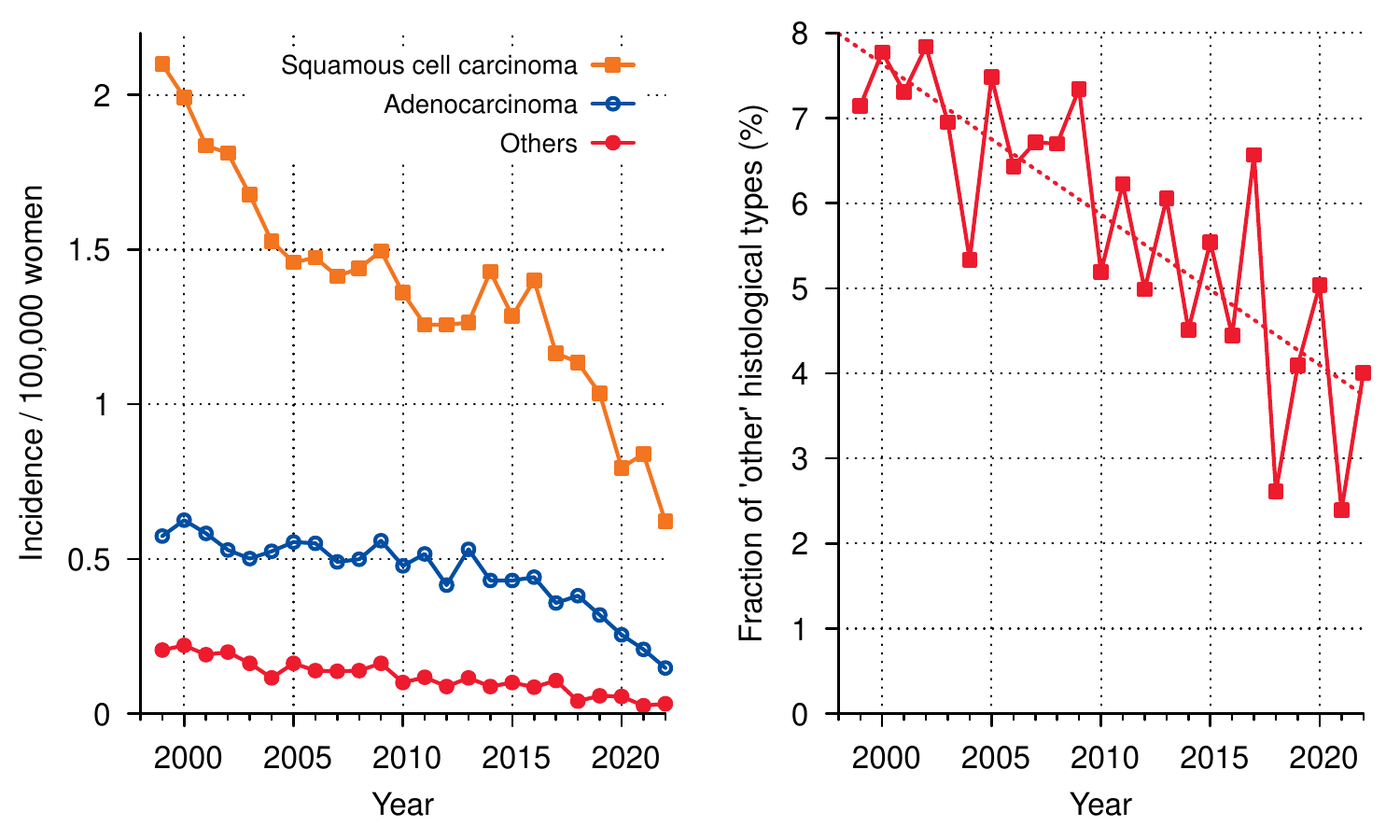
Figure 1: Incidence of cervical carcinoma among women aged 15-29 in the USA, between 1999 and 2022, by histological type. Left: data from Figure S2 in the study by Gopalani et al. Right: fractional contribution of minor histological types to the total number of cervix carcinomas. The trend line is a linear regression.
What might cause the remarkable overall decrease in the incidence of cervical carcinoma? Most likely, it is preventive screening. In keeping with this assumption, other HPV-related cancers—those of the penis, the anus, and the oropharynx—have remained level or even increased over the last several decades. As far as data are available, this also applies to young men, who would be more likely to have received the HPV vaccine than older men. While the limited information does not warrant the firm conclusion that the HPV vaccine has no preventive effect on such cancers, the opposite is equally true—as with cervical carcinoma, the records don’t substantiate any such prevention.
What conclusions should we draw from the limited evidence on cancer prevention?
The lacking evidence of significant protection from cervical carcinoma means that HPV vaccination does not at this time obviate the need for regular cancer screening. Moreover, preventive examination is simple and effective. It is noteworthy that all of the common HPV-related cancers occur at easily accessible body sites. Therefore, just like cervical carcinomas, those of the anus, the oropharynx or the penis could in principle be caught in good time by routine examination. If such preventive exams are deemed unnecessary, then there can be no urgent need for preventive vaccination either.
The HPV vaccines
The HPV vaccines use an interesting technology referred to as “virus-like particles.” These synthetic particles resemble viruses in size and shape, and just like viruses they also carry a large copy number of antigenic protein molecules on their surface. Our immune system tends to respond forcefully to virus particles, and vaccines mimicking their structure likewise tend to elicit a strong immune response. Unlike real viruses, however, these vaccine particles do not contain any copies of the viral genome; they are not to be confused with traditional live vaccines or with the poisonous adenovirus-derived vaccines against COVID-19 that were produced by AstraZeneca and Janssen.
Aside from the highly immunogenic form of antigen presentation, the HPV vaccines also contain a very powerful aluminum-based adjuvant, which serves as a nonspecific trigger of inflammation. This inflammation further amplifies the immune response to the antigen. Overall, therefore, both the antigen preparation and the adjuvant are geared toward eliciting a strong immune response. This might seem like a good thing, but it also poses risks.
The danger of immunological cross reactions
Our immune system wields some powerful weapons—it can attack all kinds of microbes, including bacteria, fungi, parasites, and viruses. To combat viruses, it also destroys cells of our own body which it recognizes as virus-infected. These weapons must of course be deployed with great deliberation in order to avoid harm to ourselves. While overall the immune system’s ability to discriminate “self” from “non-self” is remarkable, it is not infallible. Certain microbes contain antigens that trigger immune responses which attack not only the microbe in question, but also some of the body’s own molecules and cells. A well-known example is the bacterium Streptococcus pyogenes, a common cause of throat or skin infections. These are often self-limiting and also amenable to treatment with penicillin, and in most cases, they heal without any long-term sequelae. However, in some patients, the infection is followed by a severe disease called acute rheumatic fever. In this condition, the immune response that was induced by the infection cross-reacts with self antigens inside the heart, the joints, the kidneys, or even the central nervous system, causing grave harm to these organs. Another example is acute reactive arthritis induced by enteric infections with Campylobacter or Yersinia bacteria; yet another is Guillain-Barré syndrome, a serious disease of the peripheral nervous system, following an infection with the Epstein Barr Virus.
It is important to understand that the risk of such harmful cross-reactions is to a large extent determined by individual genetic traits, and in particular by the constellation of an individual’s histocompatibility antigens. These are the very same genetic markers that also determine the compatibility of organ transplants. You are likely aware that these antigens are highly variable. Just as it is unlikely that I and my next-door neighbor will be a good match for swapping bone marrow transplants, so it is unlikely that we will resemble each other in our susceptibility to autoimmune disease triggered by infectious agents. The same applies to vaccines. It follows that testing a new vaccine on a relatively small collective of volunteers cannot reliably establish the risk of adverse events due to immunological cross-reactions. And there is a further consideration: natural pathogens were present throughout human evolution, so that the most severe adverse responses were removed by natural selection. However, the same does not apply to artificial antigen preparations, i.e. vaccines. Papilloma viruses are of course ancient, too, but a natural infection with such a virus is restricted to one or a few sites on the skin or a mucous membrane, and it induces at best a muted immune response, as is evidenced by the often long persistence of such infections. In contrast, the systemic injection of a large amount of papilloma virus antigen, together with a powerful adjuvant, represents a novel and unusual immunological challenge with unforeseeable risks.5
Can HPV vaccination cause harmful cross-immunity?
Yes, it can. While it is difficult to know exactly how frequent this is, the fact as such has been established by a statistical analysis of the reports collected by the US Vaccine Adverse Event Reporting System (VAERS). To understand the rationale of this analysis, a little background on this system is in order. The purpose of VAERS is to collect putative cases of adverse events that occur after vaccination. While this is useful, there are practical limitations:
- not all events that occur are also reported; in fact, the percentage that is reported is likely in the single digits;
- some of the events that are reported may not in fact have been caused by the vaccine in question but simply happened close in time due to coincidence.
Therefore, we cannot take the numbers of such reports recorded by VAERS on a given vaccine at face value. However, it stands to reason that the proportion of purely coincidental reports should not depend on the particular vaccine in question. Therefore, if a given vaccine exceeds the average of the other vaccines in the rate of adverse events reported, then at least that surplus of reports can be considered real and substantive.
Dr. Tomljenovic has carried out a thorough comparative study along these lines. She found that certain adverse events were reported significantly more often after HPV vaccination than with all other vaccines combined (with the exclusion of COVID vaccines). Prominent among such events are autoimmune disorders such as systemic lupus erythematosus, juvenile arthritis, multiple sclerosis, and alopecia. The same applies to disruptions of the endocrine and autonomic nervous systems. HPV vaccines are likewise highly overrepresented in reports of embolism and thrombosis. Details can be found in the report cited in footnote 1. These findings are strong evidence of significant potential for immunological mechanisms of harm.
Conclusion
While it is reasonable to expect that HPV vaccines may in the long term reduce the incidence of cancer due to HPV infection, the currently available data to not prove it. The lack of evidence may be due to a multi-year time delay between infection and clinical cancer. However, a long delay also means that there is enough time to catch and avert developing cancers through regular screening. On the other hand, the risk of severe adverse events is real and substantial, even though it cannot be quantified exactly based on the limited data available. Considering that neither the benefit nor the risk can currently be accurately assessed, there simply is no basis for recommending these vaccines to the general public.
Notes
- Tomljenovic, L. (2026) Public Comment: Human Papillomavirus Vaccine (HPV) https://archive.org/details/tomljenovic-white-paper (back)
- Lei, J. et al. (2020) {HPV} Vaccination and the Risk of Invasive Cervical Cancer. N. Engl. J. Med. 383:1340-1348 http://dx.doi.org/10.1056/NEJMoa1917338 (back)
- Alcalde-Herraiz, M. et al. (2026) The effectiveness of {HPV} vaccination against invasive cervical cancer and related precancerous lesions: a multinational target trial emulation study. Lancet Prim. Care 2:100114 http://dx.doi.org/10.1016/j.lanprc.2026.100114 (back)
- Gopalani, S.V. et al. (2026) Declines in cervical cancer incidence among young women in the United States. J. Natl. Cancer Inst. 118:941-946 https://www.ncbi.nlm.nih.gov/pubmed/?term=41883186 (back)
- One could argue that the most “natural” vaccine yet invented is the polio live virus vaccine, which closely mimics not only the natural pathogen itself but also its route of infection. (back)
Leave a Reply